
Foam for the hard-to-seal places
Spray Foam Insulation in Boston, MA
Two foams, used where each one fits.
- Free on-site estimates in Boston and the inner suburbs
- Written quotes that list material, thickness and R-value for every area
- Old wiring, vermiculite and moisture flagged before any work is planned
Where Foam Earns Its Cost in an Old House
Spray foam insulation is a polyurethane product that is mixed at the gun, expands as it lands and bonds to wood, brick and stone. Its big advantage over batts and loose fill is that it stops air as well as heat. In older Boston houses, air leaks cause most of the discomfort: cold air pulled in at the sill, warm air escaping at the top plates and roof. Foam is the most direct way to close those gaps where loose fill cannot.
Open-cell
Open-cell foam is light, about half a pound per cubic foot, and expands a lot. It fills irregular cavities, stops air and dampens sound, at R-3.5 to R-3.7 per inch according to HomeGuide. It allows some water vapor through, so in Climate Zone 5A it is used where the vapor side is handled another way, or between heated floors. It costs less per square foot than closed-cell.
Closed-cell
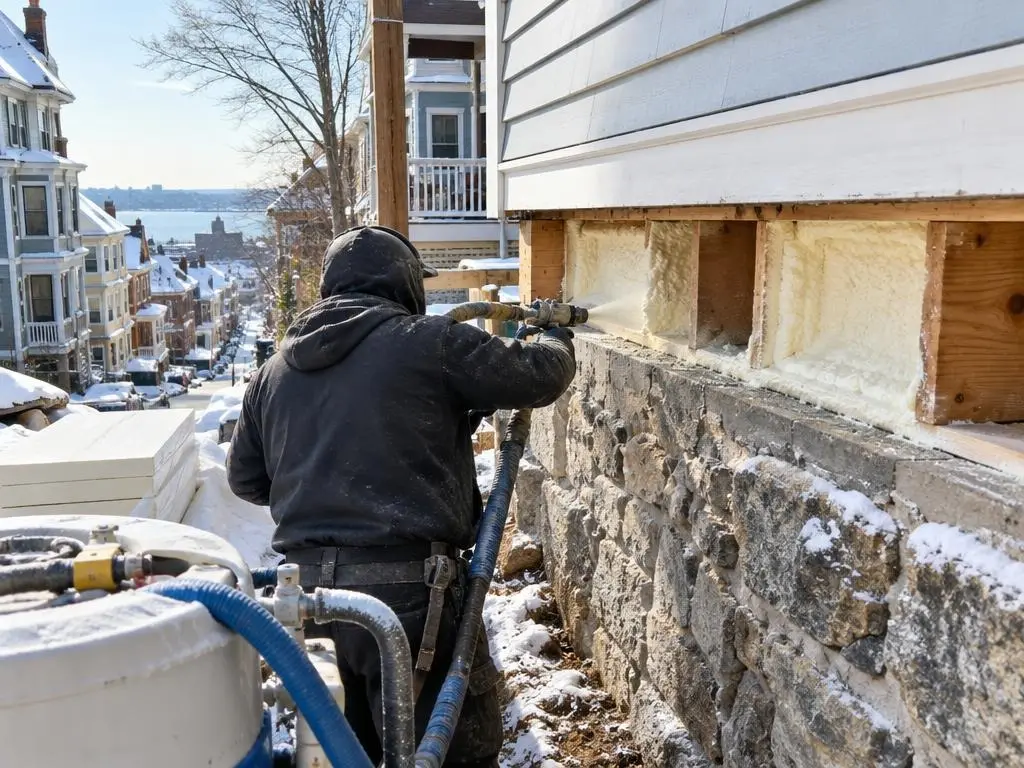
Closed-cell foam is dense, at R-5 to R-7 per inch. At typical thickness it is a vapor retarder and does not absorb water, and it adds stiffness to the surface. That makes it our usual choice for rim joists, brick and fieldstone foundation walls, the underside of low-slope triple-decker roofs, floors over open porches and anywhere space is tight. It costs more, so we use it where those properties matter.
Where foam is not the answer
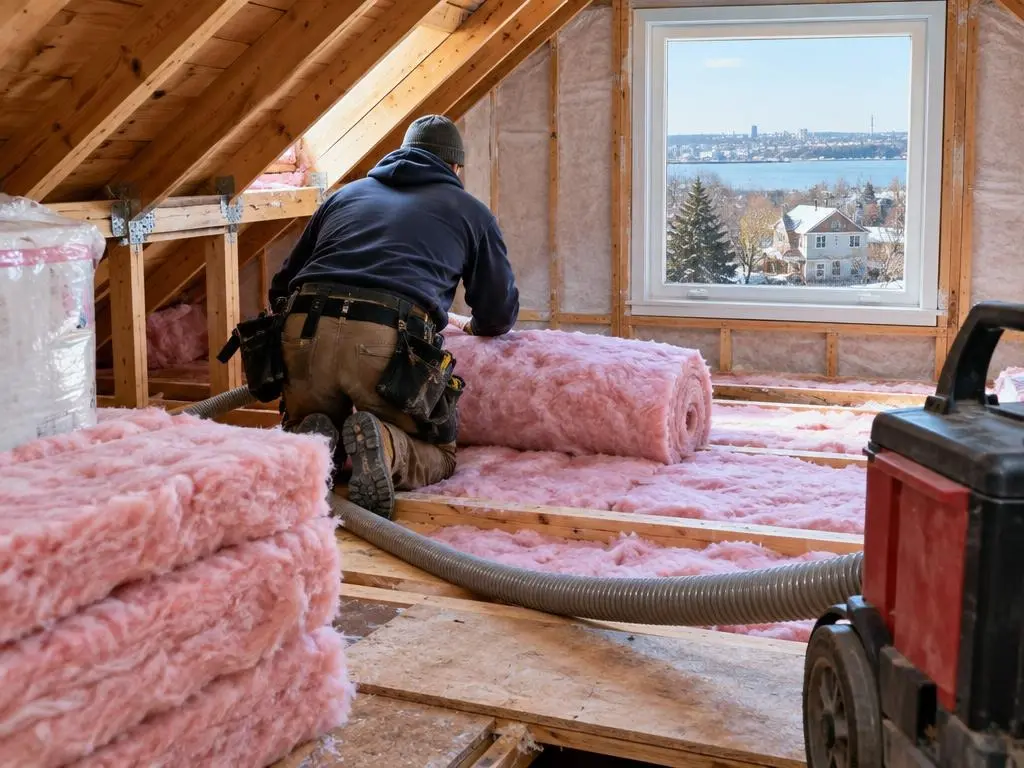
On an open attic floor, the cheapest way toward the R-60 listed in the Massachusetts stretch code summary is to seal the gaps and blow loose fill. In closed plaster walls, dense-pack cellulose is usually more practical. We will tell you when foam is not the best buy for a space.
Typical Boston foam jobs
Rim joists around the basement of a two-family. The rafters of a finished third-floor room in a Victorian. The ceiling of a top-floor triple-decker unit under a flat roof, when the cavity is too shallow for loose fill. The floor of a room built over an old porch. Exposed stud walls during a kitchen or bath gut renovation. Each of those is a case where foam's air sealing and R-value per inch make the difference.
Common Foam Applications
Each gets its own line, thickness and R-value on the quote.
Rim joists and sills
Closed-cell foam around the basement perimeter where framing meets the foundation.
Finished attic rooms
Foam in the rafters and kneewalls of third-floor rooms and converted attics.
Low-slope roofs
Closed-cell foam under flat or low-slope roof decks where there is little cavity depth.
Porch and overhang floors
Foam in floors over porches, bays and overhangs that sit on cold air.
Gut renovations
Foam in open stud bays while walls are opened.
Published Spray Foam Costs
| Work | Typical range (source) |
|---|---|
| Spray foam, installed | $1.50 to $5.00 per sq ft (HomeGuide) |
| Open-cell / closed-cell | $1.50 to $3.50 / $3.00 to $5.00 per sq ft (HomeGuide) |
| Roughly 1,000 sq ft | $1,500 to $5,000 (HomeGuide); $3,150 to $7,500 in an existing home (Fixr) |
| Existing walls / new construction | $3.15 to $7.50 / $2.75 to $6.50 per sq ft (Fixr) |
| All exterior walls | $4,000 to $10,000 (HomeGuide) |
| Whole house | $8,000 to $20,000 (HomeGuide); $10,000 to $30,000 (Fixr) |
| Minimum job charge | $1,000 to $2,000+ (HomeGuide) |
National ranges from HomeGuide (2026) and Fixr (2025). Foam type, thickness, access and prep set the actual cost, and narrow stairs or finished rooms in older Boston buildings add labor. The figure on our written estimate is what you are charged.
Foam Job Steps
1. Visit
Inspect, measure and check wiring, moisture and access.
2. Quote
Foam type, thickness, R-value and price per area in writing.
3. Prep
Protect floors and finishes, mask, close off the area and ventilate.
4. Spray
Apply foam in passes to the planned thickness and trim as needed.
5. Re-entry
Clean up and tell you when it is safe to return; HomeGuide says at least 24 hours.

Why Choose Us for Spray Foam Insulation
Foam only where it fits
Loose fill or dense-pack is suggested where it costs less for the same result.
Old-house aware
Wiring, plaster and moisture checked before anything is sprayed.
Spray Foam Insulation Questions
Is open-cell or closed-cell better for a Boston basement?
Closed-cell. It slows vapor and resists water, so it keeps humid basement air off cold brick, stone and wood.
Can foam go under a flat triple-decker roof?
Often, if the cavity can be reached. Closed-cell foam under the deck seals and insulates where there is little depth. We look at the roof structure first.
Does spray foam need a covering?
In living spaces and many basements it needs a thermal barrier like drywall, unless a product rated for exposure is used. We explain what applies before you sign.
Is spray foam safe once it cures?
After curing and ventilation, the space is reoccupied; HomeGuide's guidance is to stay out at least 24 hours. We tell you exactly when to come back.
Spray Foam Insulation Service Areas
- Spray Foam Insulation in Boston, MA
- Spray Foam Insulation in Dorchester, MA
- Spray Foam Insulation in Jamaica Plain, MA
- Spray Foam Insulation in Roslindale, MA
- Spray Foam Insulation in West Roxbury, MA
- Spray Foam Insulation in Brighton, MA
- Spray Foam Insulation in Cambridge, MA
- Spray Foam Insulation in Somerville, MA
- Spray Foam Insulation in Brookline, MA
- Spray Foam Insulation in Newton, MA
- Spray Foam Insulation in Watertown, MA
- Spray Foam Insulation in Arlington, MA
- Spray Foam Insulation in Medford, MA
- Spray Foam Insulation in Quincy, MA
- Spray Foam Insulation in Milton, MA
- Spray Foam Insulation in Dedham, MA
Get a Spray Foam Insulation Estimate
Find out where foam belongs in your house.