
Stop the heat at the top of the house
Attic & Roofline Insulation in Boston, MA
Attic floors, kneewalls and finished attic rooms.
- Free on-site estimates in Boston and the inner suburbs
- Written quotes that list material, thickness and R-value for every area
- Old wiring, vermiculite and moisture flagged before any work is planned
The Top of an Old Boston House
Attic and roofline insulation covers everything at the top of the house: the attic floor, the kneewalls and side attics of Capes and finished third floors, and the rafters of rooms built into the roof. Old Boston houses often have all three. Warm air leaks into these spaces through chases, wiring holes, light fixtures and the tops of walls, and the roof deck above gets warm enough to melt snow from below. The result is ice dams at the eaves and a top floor that is hot in July and cold in January.
Attic floors
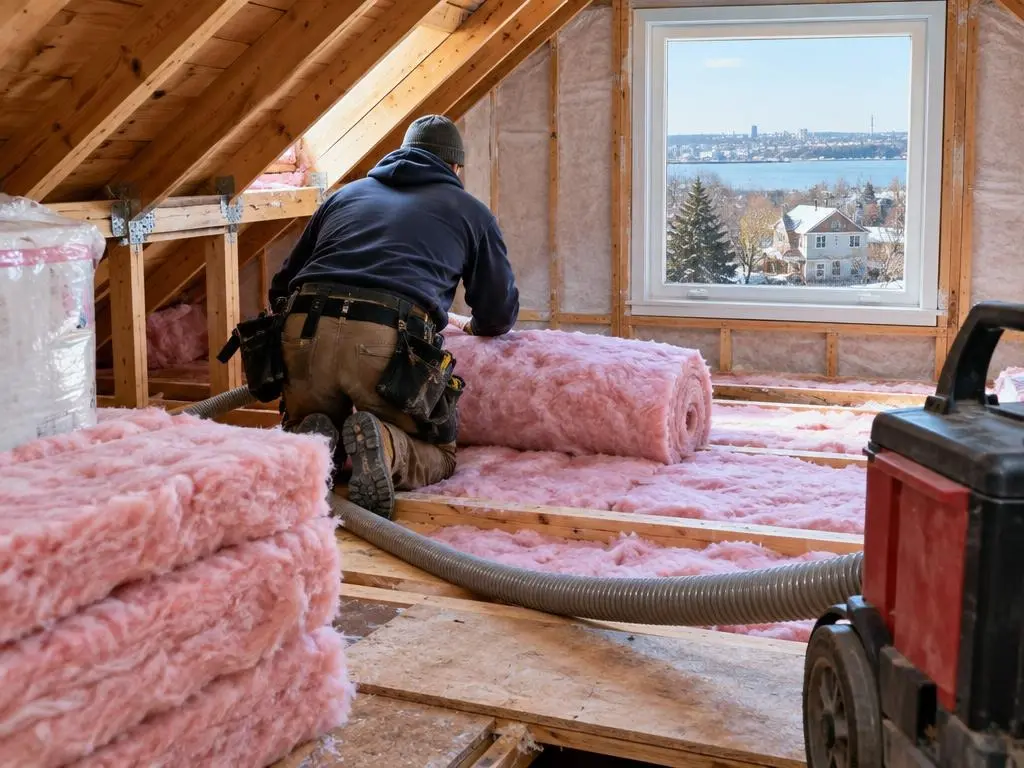
Where there is a walkable attic, the plan is simple: seal every gap in the floor, add baffles at the eaves, and blow cellulose or fiberglass to depth. The Massachusetts stretch code summary lists R-60 for new ceilings, and loose fill reaches that depth for far less than foam.
Kneewalls and side attics
Capes and many Victorians have short kneewalls with small attic spaces behind them. The floor under those spaces is often open to the heated rooms below, and the kneewall itself may have nothing behind the plaster. We seal the joist bays under the kneewall, then insulate the kneewall or move the insulation up to the roofline so the side attic becomes part of the warm space.
Finished attic rooms and low-slope roofs
When a third floor has been finished, the insulation has to follow the roof. Closed-cell foam in the rafters seals and insulates in limited depth. On low-slope triple-decker roofs, the cavity can be shallow; sometimes loose fill can be blown in through a small opening, other times foam under the deck or insulation added during a re-roof is better.
Before covering anything
We check for roof leaks, bath fans venting into the attic, damp sheathing, rodent activity, vermiculite and live knob-and-tube wiring. City of Boston guidance notes that knob-and-tube was common until the 1940s and that an inactive system does not stop insulation work. A live one needs an electrician first.
Attic and Roof Work
Sealing and insulation are separate lines on the quote.
Attic floor sealing
Foam and caulk at top plates, chases, stacks and fixtures.
Loose fill to depth
Cellulose or fiberglass blown toward R-60 after sealing.
Kneewall attics
Joist bays sealed and kneewalls or rooflines insulated.
Rafter foam
Closed-cell foam for finished attic rooms and cathedral ceilings.
Hatch and baffles
Insulated hatch cover and vent chutes at the eaves.
Published Attic Costs
| Work | Typical range (source) |
|---|---|
| Typical attic insulation job | $1,000 to $2,700, average about $1,800 (HomeGuide) |
| Air sealing | $350 to $3,000 (HomeGuide) |
| Blown-in, attic | $0.90 to $2.40 per sq ft (HomeGuide attic guide) |
| Foam on attic floor | $1,100 to $6,800 (HomeGuide) |
| Foam under roof deck | $1,500 to $9,000 (HomeGuide) |
| Attic spray foam, existing home | $2,500 to $12,000 (Fixr) |
| Old insulation removal | $1 to $2 per sq ft (HomeGuide) |
From HomeGuide's January 2026 attic guide and Fixr's 2025 foam guide. Sealing needed, target depth, access to kneewall spaces and any removal decide your price. We quote after seeing the attic, and the written estimate is the price.
Attic Work Steps
1. Inspect
Measure depth, find leaks, check wiring, moisture and vermiculite.
2. Seal
Close gaps in the attic floor and kneewall bays.
3. Insulate
Baffles, then loose fill or foam to the planned depth.
4. Leave markers
Depth rulers so you can see what was installed.
Why Choose Us for Attic & Roofline Insulation
Kneewalls handled
Side attics are planned, not skipped.
Roof structure checked
We look at low-slope roofs before recommending a method.
Attic & Roofline Insulation Questions
Will this stop my ice dams?
Sealing and insulating the attic floor removes most of the heat that melts roof snow. Ventilation and roof shape matter too, and we check both.
My third floor is finished. Can it still be insulated?
Yes, usually by spraying foam in the rafters from the side attics, or by dense-packing closed rafter bays. We look at access first.
How deep should attic insulation be?
The Massachusetts stretch code summary lists R-60 for new ceilings. With cellulose that is roughly 16 to 17 inches, and we leave depth markers so you can check.
Attic & Roofline Insulation Service Areas
- Spray Foam Insulation in Boston, MA
- Spray Foam Insulation in Dorchester, MA
- Spray Foam Insulation in Jamaica Plain, MA
- Spray Foam Insulation in Roslindale, MA
- Spray Foam Insulation in West Roxbury, MA
- Spray Foam Insulation in Brighton, MA
- Spray Foam Insulation in Cambridge, MA
- Spray Foam Insulation in Somerville, MA
- Spray Foam Insulation in Brookline, MA
- Spray Foam Insulation in Newton, MA
- Spray Foam Insulation in Watertown, MA
- Spray Foam Insulation in Arlington, MA
- Spray Foam Insulation in Medford, MA
- Spray Foam Insulation in Quincy, MA
- Spray Foam Insulation in Milton, MA
- Spray Foam Insulation in Dedham, MA
Get an Attic & Roofline Insulation Estimate
Fix the top of the house first.