
A city of old houses and nor'easters
Spray Foam Insulation in Boston, MA
Air sealing and insulation for Boston's older housing.
- Free on-site estimates in Boston and the inner suburbs
- Written quotes that list material, thickness and R-value for every area
- Old wiring, vermiculite and moisture flagged before any work is planned
Insulating an Old Coastal City
Spray Foam Insulation in Boston has to work with very old buildings on unusual ground. Wikipedia notes that more than two-thirds of inner Boston's modern land area did not exist at the city's founding; marshes, mud flats and gaps between wharves were filled between 1631 and 1890. Neighborhoods that were once separate towns, like Dorchester, Brighton, Jamaica Plain and West Roxbury, joined the city in the 1870s and filled with streetcar-era housing. Downtown and nearby areas are mostly low-rise masonry buildings.
Climate
Wikipedia's climate summary lists 43.6 inches of precipitation and 49.2 inches of snow a season, with most snow from mid-November to early April and high variation from year to year. The city is prone to nor'easters. Sea breezes in late spring can make the coast more than 20 degrees colder than a few miles inland. Wind and wet snow both test a leaky house.
Housing types
In the streetcar neighborhoods, triple-deckers and two-families line many streets. In older districts, brick row houses and masonry buildings dominate. On the edges of the city, single-family Colonials, Capes and Tudors are more common. Each has different weak spots: the roof cavity and walls of a triple-decker, the top floor and party walls of a row house, the kneewalls and rim joist of a Cape.
Damp basements
On filled land and near the harbor, basements can run damp. Closed-cell foam on the rim keeps humid air off cold wood, but standing water or seepage has to be handled first.
City help with barriers
The City of Boston's guidance on insulation barriers describes knob-and-tube wiring as common until the 1940s, notes that an inactive system does not stop insulation, and lists a Mass Save barrier incentive of up to $7,000 for income-verified households plus a 0% HEAT Loan for barrier fixes. It also points income-eligible residents to ABCD's no-cost weatherization.
Mass Save first, if you want incentives
Mass Save lists no-cost assessments for one- to four-unit homes and 75 to 100 percent off approved insulation improvements. Book the assessment first if you want those incentives. For foam work outside the program, we price directly.
Timing around the weather
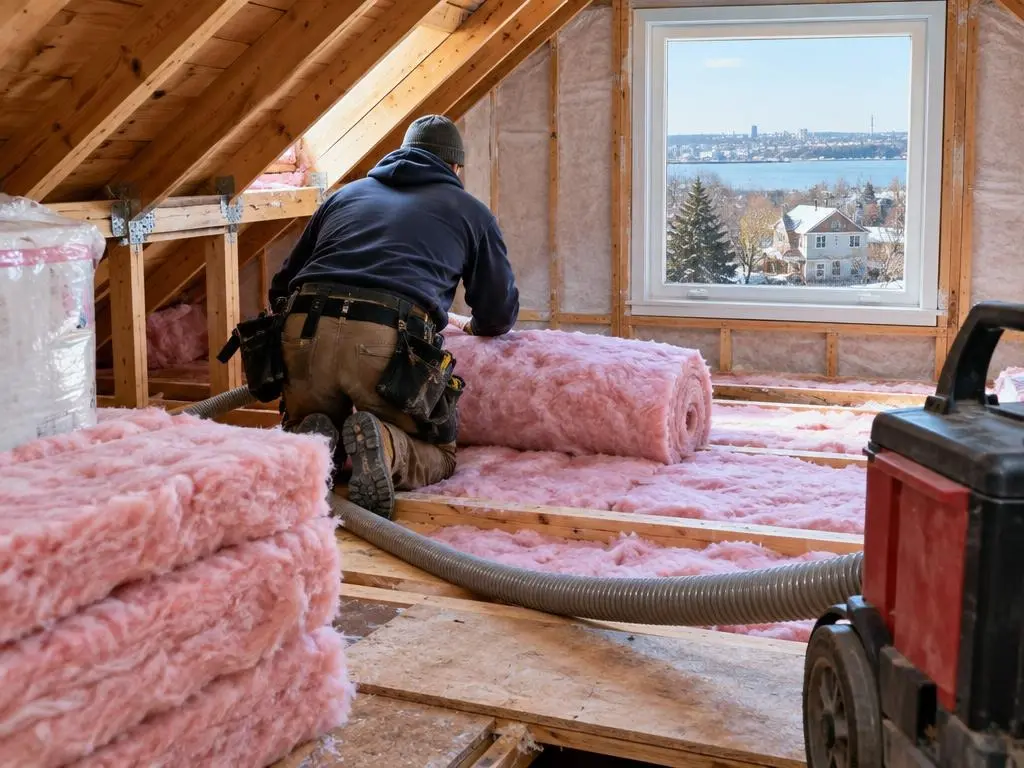
Basements and heated rooms can be insulated in any month. Attics and unheated roof cavities are easier outside the coldest weeks, because foam needs the surface and the material within a working temperature range and loose fill goes in faster when the attic is not frozen. With most of Boston's snow falling from mid-November to early April, many owners book in late summer or early fall. We set the date around the forecast and your schedule.
What a visit covers
We look at the attic or roof cavity, the walls, the basement and any finished attic rooms, check for barriers, and send a written quote by area. Get a free estimate
What to Know in Boston
- Filled land. More than two-thirds of inner Boston's land area did not exist at founding; marshes and flats were filled from 1631 to 1890 (Wikipedia).
- Snow and rain. Boston averages 43.6 inches of precipitation and 49.2 inches of snow a season, mostly mid-November to early April (Wikipedia).
- Sea breeze. In late spring the coast can be more than 20F colder than a few miles inland because of sea breezes (Wikipedia).
- Barrier help. City guidance lists a Mass Save barrier incentive up to $7,000 (income verified) and a 0% HEAT Loan for fixes like knob-and-tube or vermiculite.
- Climate zone. Massachusetts is in Climate Zone 5A; the stretch code summary lists R-60 ceilings for new work.
Boston Questions
Do you work in every Boston neighborhood?
Yes, across the city, including Dorchester, Jamaica Plain, Roslindale, West Roxbury, Brighton and the older central neighborhoods.
Can row houses be insulated?
Yes. The roof and top-floor ceiling are usually the biggest gains, along with the basement rim. Shared party walls lose less heat than exposed walls.
What if my house has knob-and-tube wiring?
If it is inactive, insulation can go ahead. If it is live, an electrician addresses it first. City guidance mentions a 0% HEAT Loan for that work.
Is parking a problem for your equipment?
On dense streets we plan ahead. Let us know about permit parking or tight driveways when you book.
When is the best time to book?
Late summer and early fall give the most choice of dates. Basement work can happen any time of year.
Free Estimates in Boston, MA
Boston homeowners: book a free estimate.
Spray Foam Insulation Near Boston
- Spray Foam Insulation in Dorchester, MA
- Spray Foam Insulation in Jamaica Plain, MA
- Spray Foam Insulation in Roslindale, MA
- Spray Foam Insulation in West Roxbury, MA
- Spray Foam Insulation in Brighton, MA
- Spray Foam Insulation in Cambridge, MA
- Spray Foam Insulation in Somerville, MA
- Spray Foam Insulation in Brookline, MA
- Spray Foam Insulation in Newton, MA
- Spray Foam Insulation in Watertown, MA
- Spray Foam Insulation in Arlington, MA
- Spray Foam Insulation in Medford, MA
- Spray Foam Insulation in Quincy, MA
- Spray Foam Insulation in Milton, MA
- Spray Foam Insulation in Dedham, MA